
Accessibility Is Not a Bonus—It Is the Litmus Test for Public Mobility
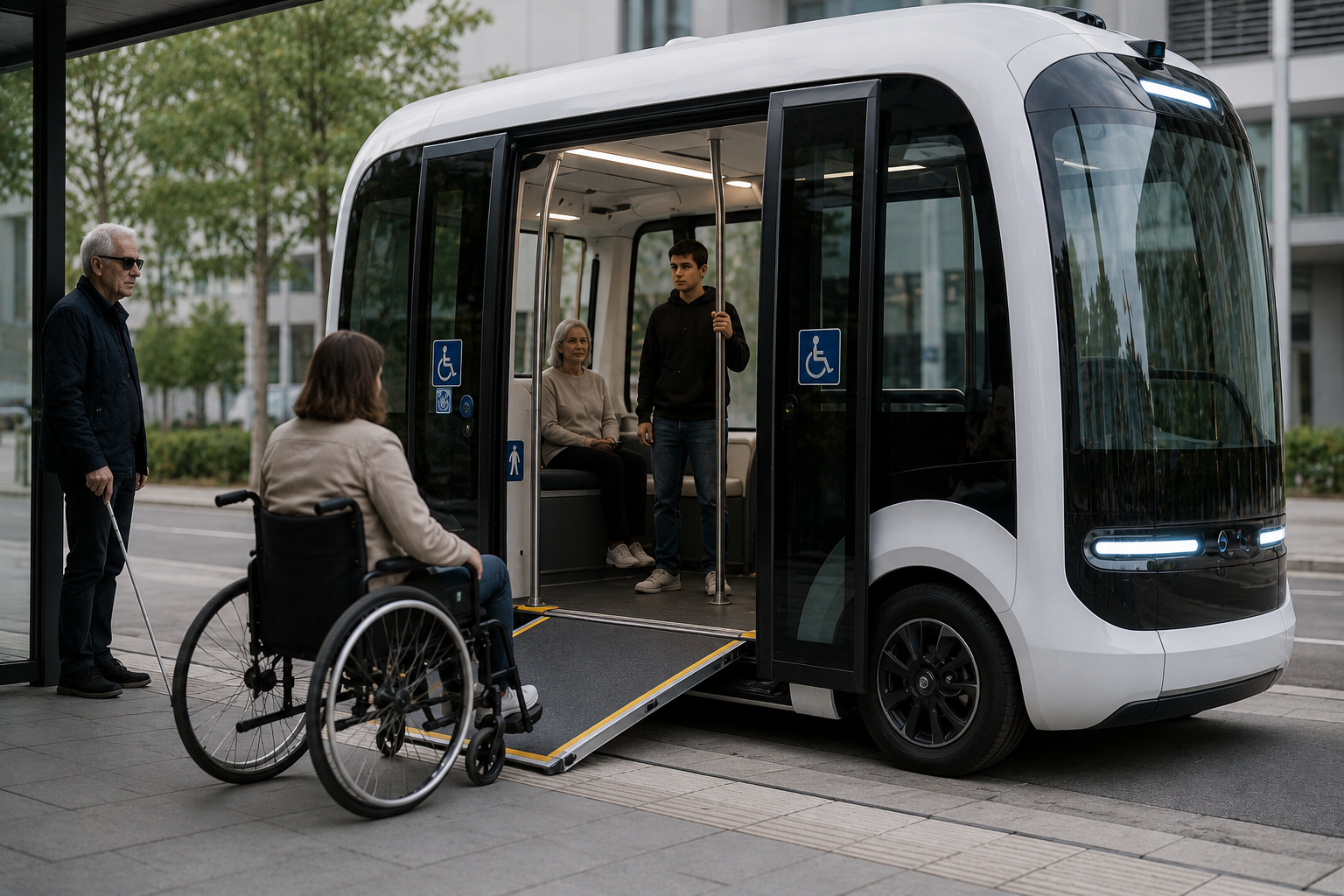
Autonomous mobility will only become relevant if it not only works technically but also enables more people to be mobile.
That is precisely why accessibility is not a secondary consideration. Nor is it a feature to be added at a later stage. It is the benchmark for whether new technology actually translates into inclusive and publicly valuable mobility. The true value of a system is not revealed where mobility is already easy. It becomes visible where mobility is currently difficult, unsafe, or unreliable for people.
The German federal government explicitly describes autonomous driving as an opportunity to improve participation, quality of life, and mobility for people who cannot or do not wish to drive themselves.
Source: More information
The political direction is therefore clear. Autonomous mobility is not justified solely by innovation, efficiency, or technological expertise. It is also explicitly linked to societal benefits: improved accessibility, greater independence, and new mobility options in situations where existing services often fall short today.
Public transportation must be accessible to as many people as possible—not only to those who are already comfortable with digital tools and able to move around without restrictions. Anyone discussing the future of public transportation must therefore also consider whether vehicles, stops, booking systems, information services, and operational processes are designed in a way that enables meaningful participation for people with a wide range of disabilities.
The Handbook on Autonomous Driving in Public Transport explicitly identifies accessible and safe vehicles as a dedicated aspect of planning and operations.
Source: More information
This is not merely a technical requirement. It must be a guiding principle in planning. Accessibility is not simply a matter of entering and exiting a vehicle. It begins much earlier: with where a service operates, how it can be booked, how information is communicated, how safely boarding and alighting are organized, and how reliably a system performs in everyday situations. Those who consider accessibility too late risk overlooking one of the core objectives of public mobility.
That is why accessibility is not only a social standard. It is also one of the most demanding real-world tests for autonomous mobility. In situations where people depend on precise, reliable, and safe interaction, technical functionality alone is not enough. This is where it becomes clear whether control truly performs under real-world conditions: through precise acceleration, safe stopping, predictable vehicle behavior, smooth boarding and alighting, and reliability throughout the entire user journey.
In this context, autonomous mobility has the potential to achieve more than a traditional technology project. It can create mobility services that are more precise, more responsive to individual needs, and better integrated into everyday life. This is particularly relevant for older adults, people with limited mobility, and communities where mobility options remain limited or difficult to access. This is precisely why the German federal government links autonomous mobility to more equitable living conditions and improved access to mobility.
This is also where the technological importance of accessibility becomes apparent. Accessibility is not simply one application among many. It demonstrates particularly clearly whether a system can control movement in a way that results in genuine usability in everyday life.
For Arnold NextG, this is not an abstract concept but part of our own development history. Drive-by-wire technology first became relevant in applications where precise, reliable, and controllable movement is not optional—it is essential. That is why accessible mobility is not only socially important to us, but also highly significant from a technological perspective. Anyone seeking to master movement in these sensitive application environments needs more than a convincing demonstration system. They need a deep understanding of how control is implemented technically and maintained reliably in real-world operation.
Source: More information
An international perspective: Japan also explicitly links autonomous driving to public services and regional mobility. Ministry documents identify three central requirements for implementation: “1 safety improvement, 2 regional understanding, 3 business viability.” Public value does not begin with the technology itself. It begins with the question of whether mobility becomes accessible, accepted, and sustainable for the people who depend on it.
Following the discussion of how autonomous mobility in public transportation must be designed at a regional and operational level, this leads to perhaps the most important public question of all:
Who is this system actually being built for?
The answer determines whether autonomous mobility remains merely another technical option or becomes credible public infrastructure. Accessibility is therefore not a niche concern for specific user groups. It is the litmus test for whether a system fulfills its public purpose—and whether it can be sustainably operated in everyday life.