
More Uptime: Arnold NextG on Drive-by-Wire, Safety-by-Wire® and Control-by-Wire® in Commercial Fleets
[Translate to English:]
When autonomous commercial vehicles are discussed, the conversation often begins with sensors, software, or approval requirements. In actual operations, however, another issue quickly moves to the forefront: whether a vehicle performs reliably in everyday use.
For commercial vehicle fleets, this is central. Availability has a direct impact on utilization, deployment planning, service, and costs. If a vehicle experiences unplanned downtime, the consequences do not remain limited to the technical level. They affect processes, schedules, and overall business performance. The higher the level of automation, the more decisive the vehicle architecture becomes.
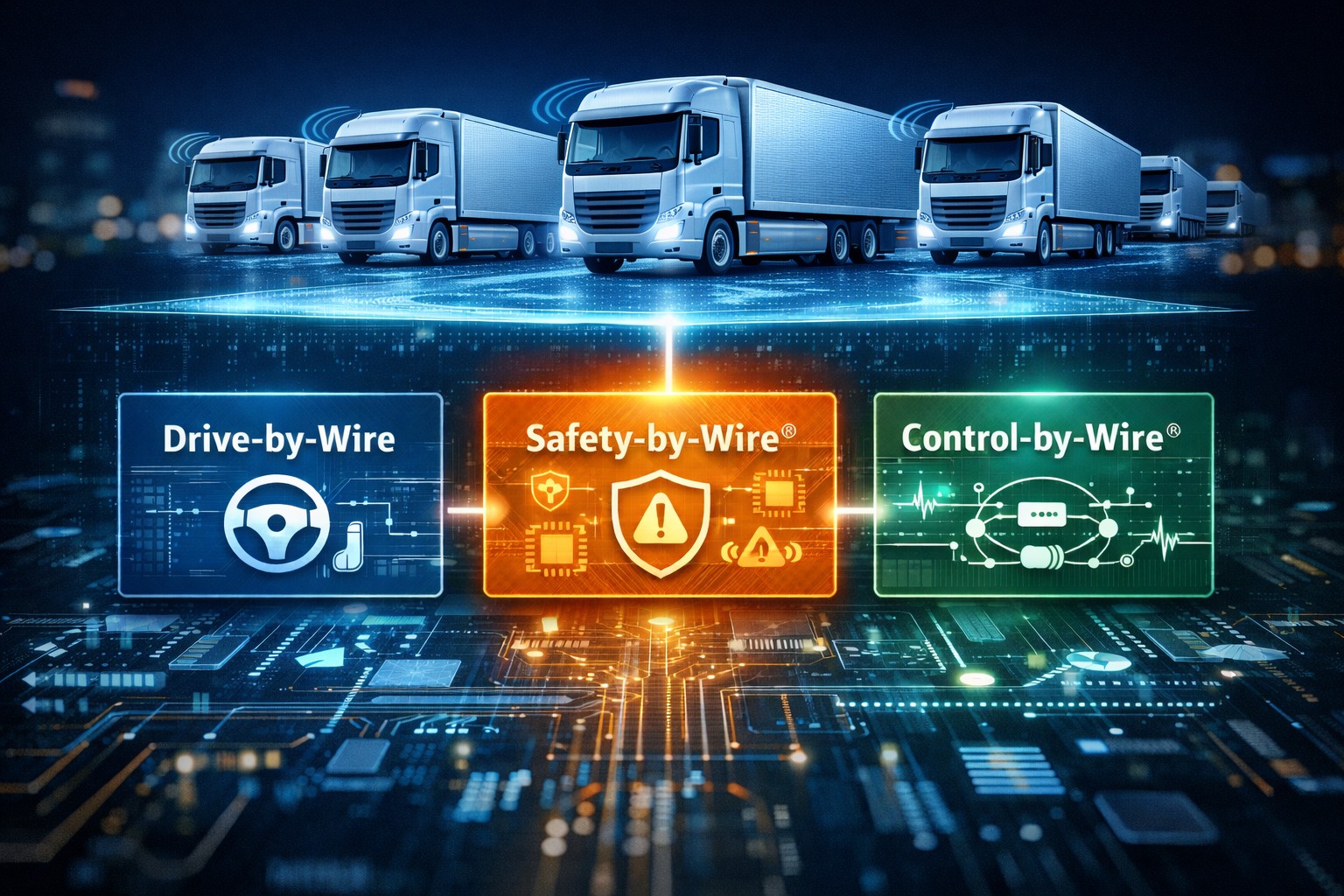
We describe this relationship across three layers. Drive-by-Wire is the technical execution layer. It is where steering, braking, and propulsion are electronically controlled. Safety-by-Wire® stands for the architecture that safeguards these functions. Control-by-Wire® describes the interaction of both layers inside the vehicle.
In conventional commercial vehicles, many irregularities can still be absorbed by the driver or the workshop. In autonomous operation, that margin is smaller. When safety-relevant functions are no longer executed properly, the issue does not remain a technical irregularity for long. It immediately becomes operationally relevant.
That is why it is too narrow to view Drive-by-Wire merely as the electronic replacement of mechanical or hydraulic connections. In autonomous applications, what matters above all is how reliably commands are executed under real-world conditions. Not under ideal circumstances, but in day-to-day operation. This becomes especially visible in steer-by-wire and brake-by-wire. These are the areas where it quickly becomes clear whether a vehicle remains controllable when faults occur or when individual signals deviate from the specified norm.
It is just as important to look at how a system handles faults. It is not enough for everything to work as long as all conditions remain in the green zone. A vehicle must also remain controllable when partial faults occur, values become implausible, or components fail. For us, Safety-by-Wire® stands for exactly this logic: redundancy, diagnostics, plausibility checks, fault isolation, fallback strategies, and degradation concepts must work together. The goal is not a theoretically fault-free system. The goal is to preserve vehicle controllability and operational capability for as long as possible, or to ensure a safe transition into a controllable state.
That is why we do not look at execution and safeguarding separately. Precise vehicle dynamics alone are not enough if fault behavior remains too vulnerable. Conversely, even the best safety logic is of limited value if the vehicle’s response in real-world use is not robust enough. Control-by-Wire® describes this relationship. In operation, what ultimately matters is not the quality of a single function, but how resilient the overall system performs.
At this point, the question of a concrete figure often comes up. By how much does a system like this increase fleet availability? For NX NextMotion, there is currently no publicly available field study from which a percentage increase in availability can be directly derived. What can clearly be described, however, are the characteristics of an architecture that fundamentally supports higher availability: redundancy, fault isolation, monitoring, and fail-operational behavior.
External studies help put the economic dimension into perspective. McKinsey cites the potential for 5 to 15 percent higher asset availability and 18 to 25 percent lower maintenance costs in digitally supported reliability programs. The U.S. Department of Energy points to cost advantages of 8 to 12 percent for predictive maintenance compared with purely preventive maintenance. These figures do not refer to a single drive-by-wire system. But they do show that diagnostics, condition monitoring, and condition-based maintenance can be real levers for availability and cost.
The fact that unplanned downtime is expensive is nothing new in fleet operations. It ties up personnel, disrupts deployment schedules, and increases workload in dispatch and service. A robust system does not automatically solve every cost issue. But it can improve the conditions for detecting faults earlier, narrowing down causes more precisely, and planning maintenance more effectively.
As automation increases, the perspective on maintenance changes as well. In conventional fleets, many decisions are still based on intervals, experience, and visual inspection. Highly automated vehicles require a more precise assessment of the condition of safety-critical systems. At that point, it is no longer enough for a vehicle to be fundamentally operable. It must also be monitorable, diagnosable, and controllable in the event of a fault.
Another point is often underestimated from our perspective: the stability of autonomous commercial vehicles is not determined by sensors or software alone. It is at least equally important whether interfaces, signal paths, diagnostic concepts, and actuation are designed as one coherent overall architecture. Integration issues rarely appear in the laboratory first. They are more likely to surface in operation, under load, over longer periods of time, or in edge-case conditions.
The economic debate around autonomous commercial vehicles often focuses on labor costs, productivity, and scaling. But these TCO effects depend on the vehicle’s technical foundation being stable enough for regular operation in the first place. The World Economic Forum describes the potential for up to 45 percent lower total cost of ownership for autonomous trucks at larger rollout scale. That figure refers to the overall transport solution, not just the in-vehicle architecture. But it does show how closely economic effects are tied to technical resilience.
For us, that is exactly the core point. Drive-by-Wire describes the execution layer. Safety-by-Wire® stands for safeguarding. Control-by-Wire® describes how both work together. The focus therefore shifts away from individual components and toward the broader question of whether a vehicle can be operated in everyday use in a way that is robust, maintainable, and economically viable.

Sources and further reading
The external figures and market data referenced in this article are based on the following primary and industry sources:
- McKinsey – Digitally enabled reliability: Beyond predictive maintenance
https://www.mckinsey.com/capabilities/operations/our-insights/digitally-enabled-reliability-beyond-predictive-maintenance - McKinsey (direct PDF link) – Digitally enabled reliability: Beyond predictive maintenance
https://www.mckinsey.com/~/media/McKinsey/Business%20Functions/Operations/Our%20Insights/Digitally%20enabled%20reliability%20Beyond%20predictive%20maintenance/Digitally-enabled-reliability-Beyond-predictive-maintenance.pdf - U.S. Department of Energy / FEMP – Operations & Maintenance Best Practices Guide: Release 3.0
https://www.energy.gov/femp/articles/operations-and-maintenance-best-practices-guide-achieving-operational-efficiency - U.S. Department of Energy / FEMP (direct PDF link) – Operations & Maintenance Best Practices Guide
https://www.energy.gov/sites/prod/files/2020/04/f74/omguide_complete_w-eo-disclaimer.pdf - ATRI – American Transportation Research Institute – Operational Costs of Trucking
https://truckingresearch.org/about-atri/atri-research/operational-costs-of-trucking/ - ATRI – An Analysis of the Operational Costs of Trucking: 2025 Update
https://truckingresearch.org/2025/07/an-analysis-of-the-operational-costs-of-trucking-2025-update/ - World Economic Forum – Autonomous Trucks: An Opportunity to Make Road Freight Safer, Cleaner and More Efficient
https://www.weforum.org/publications/autonomous-trucks-an-opportunity-to-make-road-freight-safer-cleaner-and-more-efficient/ - World Economic Forum (direct PDF link) – Autonomous Trucks
https://www3.weforum.org/docs/WEF_Autonomous_Vehicle_Movement_Goods_2021.pdf