
Precision Remote Operations
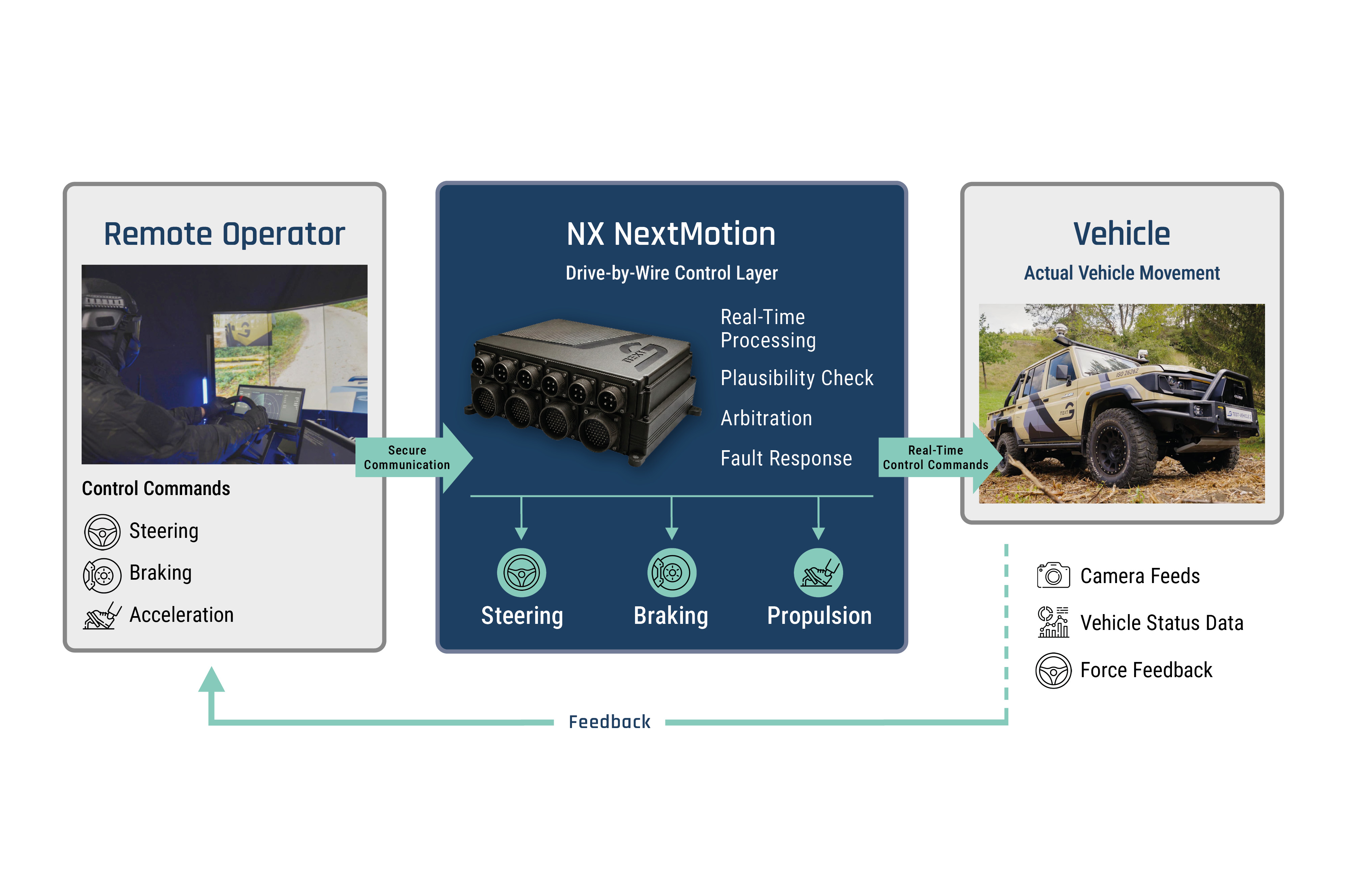
Closed-loop drive-by-wire control system for teleoperation: control commands, vehicle motion, and feedback are integrated into a single architecture. Photo: Arnold NextG
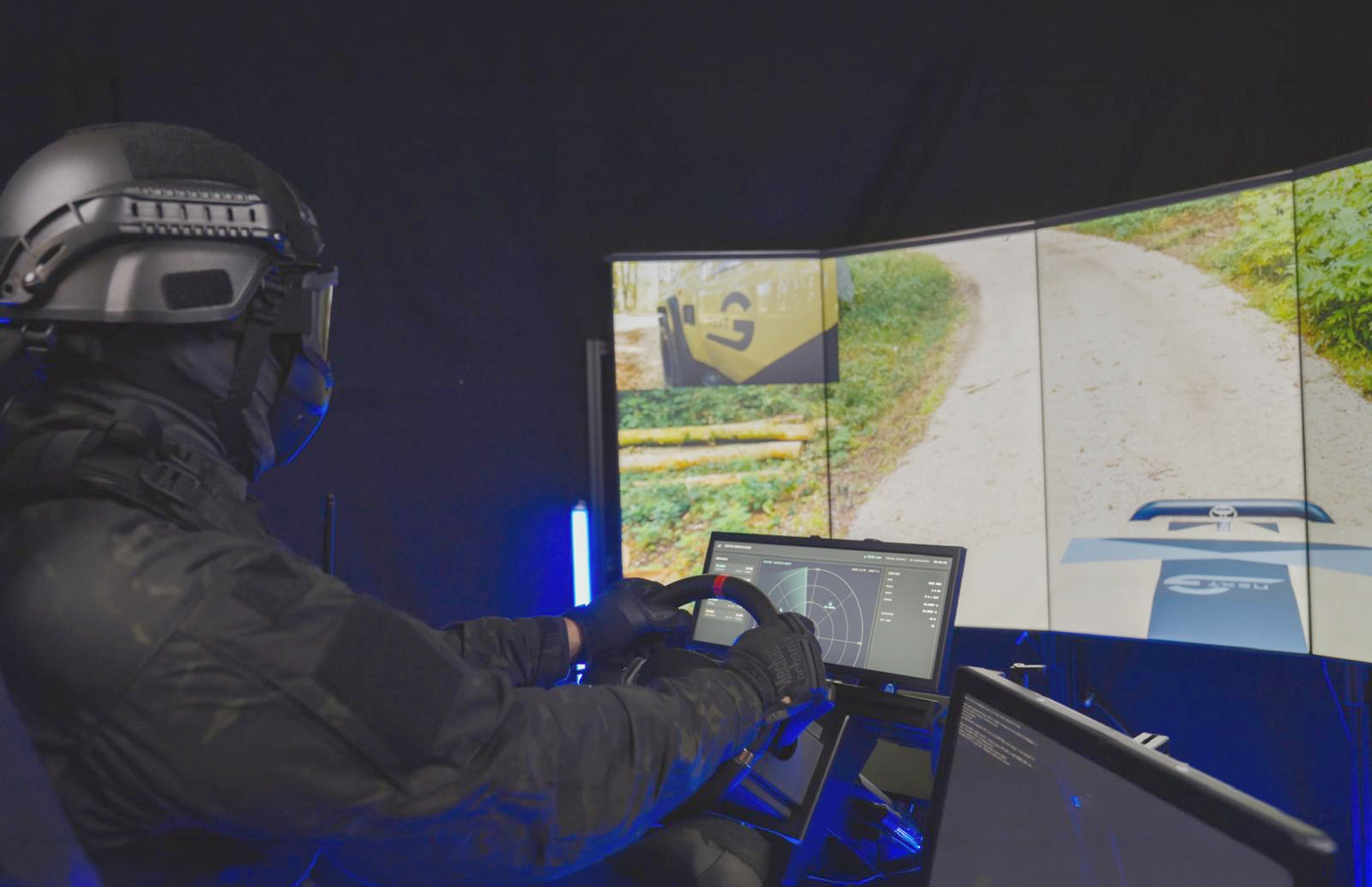
Teleoperation in practice: The remote operator controls the platform via drive-by-wire and receives feedback through visual, data, and haptic channels. Photo: Arnold NextG
Precision Remote Operations: Why Teleoperation Requires a Closed-Loop Drive-by-Wire Control System
Teleoperation does not begin with the radio connection, but with the controlled execution and feedback of vehicle movement.
TECHNOLOGICAL CORE:
Arnold NextG’s NX NextMotion connects external control commands to steering, braking, and propulsion—in real time, with feedback, and with a focus on safety.
Drive-by-wire decouples vehicle movement from exclusively mechanical operation by a driver. Steering, braking, and propulsion are controlled via electronic signal paths. This allows requirements from different control sources to be translated into actual vehicle movement in a controlled manner—regardless of whether they originate from a driver, a remote operator, or an automated driving system.
This is precisely the technical foundation for teleoperation. A radio link can transmit control commands. However, it does not ensure that the vehicle implements these commands precisely, plausibly, and in a fault-tolerant manner—nor does it ensure that the operator receives reliable feedback on the vehicle’s actual response. Only the drive-by-wire architecture creates a continuous, feedback-based control path from the external operator station to the actual vehicle movement and back.
What Drive-by-Wire Offers for Teleoperation
In a drive-by-wire architecture, control commands are captured, processed, checked for plausibility, and then implemented via the actuators. At the same time, the system monitors the status of the involved components and can respond to detected errors with defined actions.
For a teleoperated platform, this results in four key capabilities: electronic access to motion functions, precise implementation of external control commands, feedback on actual vehicle behavior, and defined responses in the event of limited system availability.
Teleoperation is therefore not a separate remote-control module that is retrofitted to a vehicle. It is a potential control source within the safety-critical motion architecture.

When the driver is no longer in the vehicle
Electronic controllability presents another challenge: the remote operator is located outside the vehicle. Immediate feedback via the steering wheel, brake pedal, driver’s seat, and vehicle movement is no longer available.
Depending on the system design, relevant feedback regarding steering forces, slip, vehicle response, or road surface conditions can be provided to the operator via appropriate visual, digital, or haptic feedback channels. The operator needs more than just information about where the vehicle is moving; they must also be able to recognize how the platform responds to his inputs.
Transmission time also becomes part of the control loop. A civilian reference framework for teleoperation specifies a maximum total latency of 200 milliseconds, including the communication link. This value is not a defence requirement, but it illustrates how closely transmission, processing, and vehicle response must be coordinated from a technical standpoint.
Force feedback is part of the vehicle control system
Force feedback is often understood as an enhancement to the user experience. With NX NextMotion, haptic feedback is an integral part of the safety-critical steering path. In the specific safety concept, it is classified as being just as safety-critical as the steering itself, based on the fault tree analysis. This classification describes the NX NextMotion system concept and is not a universally applicable statement regarding standards.
The decisive factor is the source of the feedback. Resistance generated exclusively within the operator interface can simulate a plausible sensation but does not necessarily reflect the actual state of the physical platform. NX NextMotion generates the haptic feedback based on plausibility-checked physical and vehicle-dynamics variables.
Force feedback thus becomes part of a closed-loop motion control system. The processing is subject to the same real-time, redundancy, and error response requirements as the rest of the steer-by-wire function. The control and diagnostic cycle of NX NextMotion is two milliseconds.
Controllable Without a Driver as a Fallback
In an unmanned platform, no driver is present in the cabin to take over if a function fails. Communication, sensors, actuators, control systems, and power supply must therefore be considered as an integrated safety-critical control path. A communication failure or the failure of a signal path must not lead to uncontrolled vehicle movement. The architecture must detect errors, evaluate the remaining functionality, and trigger a defined response.
NX NextMotion therefore treats external operation not as an additional function, but as a control source within a control layer designed to be fail-operational. This creates the technical foundation for teleoperated specialized platforms as well as for retrofitted existing vehicles.
Outlook
This clarifies how a single platform can be precisely controlled remotely with feedback. However, defence fleets consist of very different vehicles. The next article will show which parts of a safety-critical control layer can be reused across platforms—and where integration must remain platform-specific.
We control what moves.
Source / Technical Classification:
ATZheavyduty 02/2026, technical article “Three Control Sources, One Architecture—A Fail-Operational Drive-by-Wire Platform for Integrated Control of Autonomy, Teleoperation, and Driver Intervention.”