
Scaling Requires System Architecture
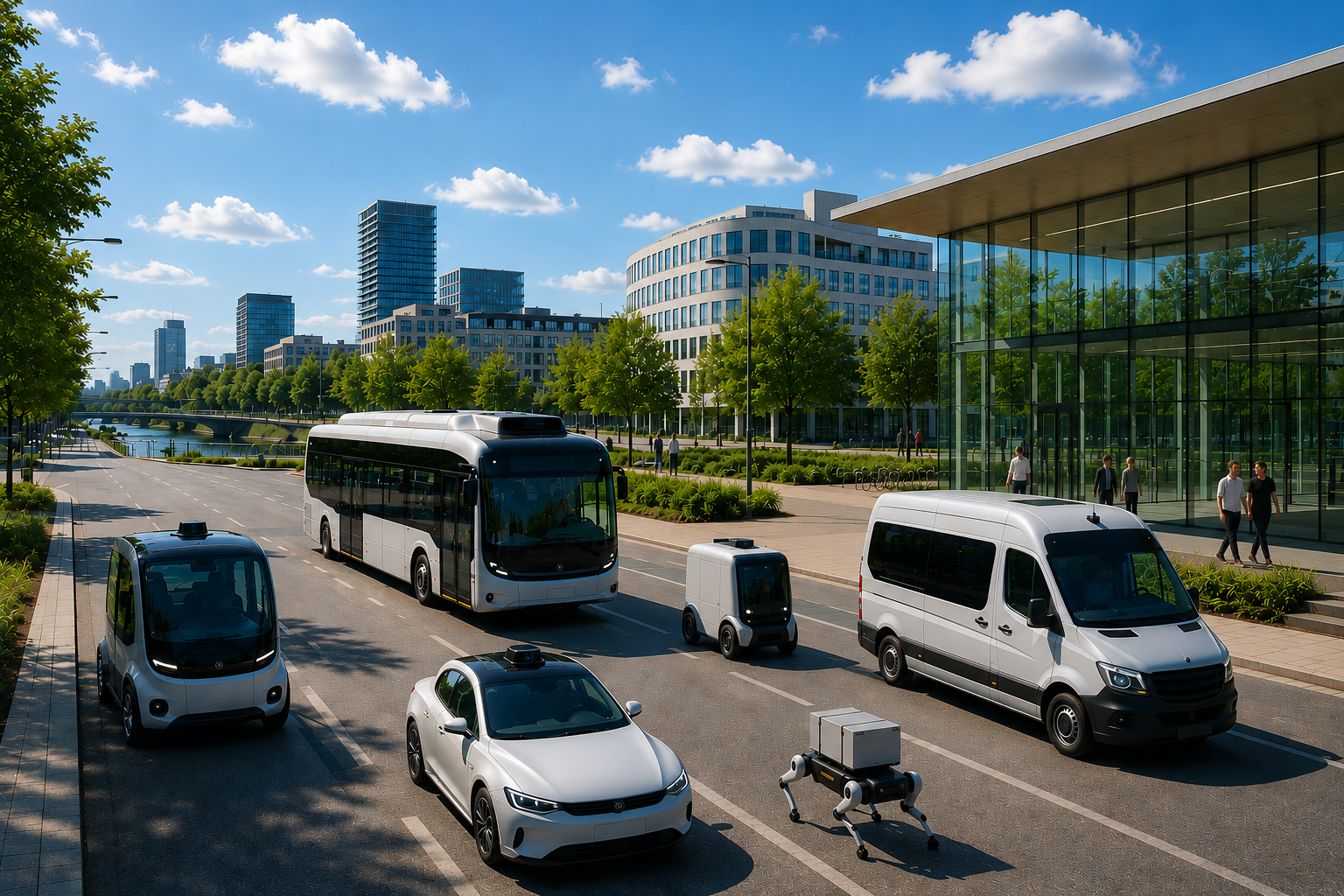
Why Control Must Not Depend on Individual Vehicle Platforms
Autonomous mobility does not scale simply by putting more vehicles on the road. It only scales when operational control becomes reliable and reproducible across different vehicle platforms.
If autonomous mobility is to become relevant at public scale, it is not enough to simply get individual vehicles to drive. The underlying system architecture must also be robust.
This is because in a pilot project, many issues can still be mitigated: through limited operational areas, defined scenarios, additional intervention options, and manageable integrations. In scaled-up operations, this logic no longer works. The more vehicles, operational areas, and platform variants are added to the system, the more apparent the real question becomes: How can vehicle movement remain controllable across different platforms, conditions, and operational states?
This is a problem that receives too little attention in many debates. Scaling is often described primarily as a matter of software, fleet size, or regulatory approval. In reality, the limit often arises much deeper within the system: where vehicle control remains tightly coupled to individual platforms, architectures, or integrations.
At first glance, this sounds technical, but in reality it is an operational issue. After all, when every new vehicle platform brings with it new interfaces, new integrations, and new system behaviors, it’s not just the workload that increases. Uncertainty also grows. Vehicle behavior becomes harder to reproduce consistently. And that is precisely what is critical in public transportation.
After all, a public system should not just be innovative. Above all, it must be predictable and reliable. Passengers, operators, and public authorities do not need a vehicle that impresses under ideal conditions. They need a system that works in everyday life—even when conditions vary, when components are not operating at their nominal state, or when fleets grow across different vehicle types.
This is the point at which vehicle technology becomes system architecture.
The Handbook on Autonomous Driving in Public Transportation describes autonomous services as a systemic challenge in which operations, safety, technical oversight, and organizational implementation must be considered together.
Source: More information
An international perspective: France, too, is not merely discussing automated vehicles, but specifically “automated vehicles and mobility services.” That is precisely what is relevant here. Once deployment is conceived as a mobility service, it is no longer sufficient to simply integrate isolated technical solutions independently. The central question then becomes how control is organized in a systemic and scalable manner.
Source: More information
What is needed for this is more than a functioning individual integration. It requires an architecture in which control is not re-engineered for each new platform. After all, fail-operational systems cannot be credibly scaled if every vehicle introduces its own logic, its own integration burden, and its own behavior into the overall system.
This is particularly relevant for public transportation. Vehicles must behave consistently. Fleets must be scalable. Systems must remain manageable. And operators must be able to rely on the fact that control does not have to be reevaluated from scratch with every new platform.
This is the point at which it is decided whether a technical function becomes a scalable system: when control is no longer conceived as a property of individual vehicles, but as a consistent, responsible layer within the overall system across different vehicle types.
This creates a new level within the system: a control layer responsible for vehicle motion—regardless of individual vehicle platforms.
This also shifts the role of drive-by-wire. It is no longer merely the electronic execution of steering, braking, or driving functions. Rather, it serves as the foundation for organizing control as an independent, platform-independent, and fail-operational system layer. Arnold NextG describes Drive-by-Wire and NX NextMotion precisely in this context as a scalable, platform-independent technological foundation for modern vehicle architectures.
Source: Drive-by-wire by Arnold NextG
Source: NX NextMotion
Anyone who seriously wants to bring autonomous mobility into regular operation in public transit must not treat system architecture as a technical detail. It determines whether individual pilot solutions can be developed into a robust public system.