
The Driver Shortage Is No Longer a Marginal Issue
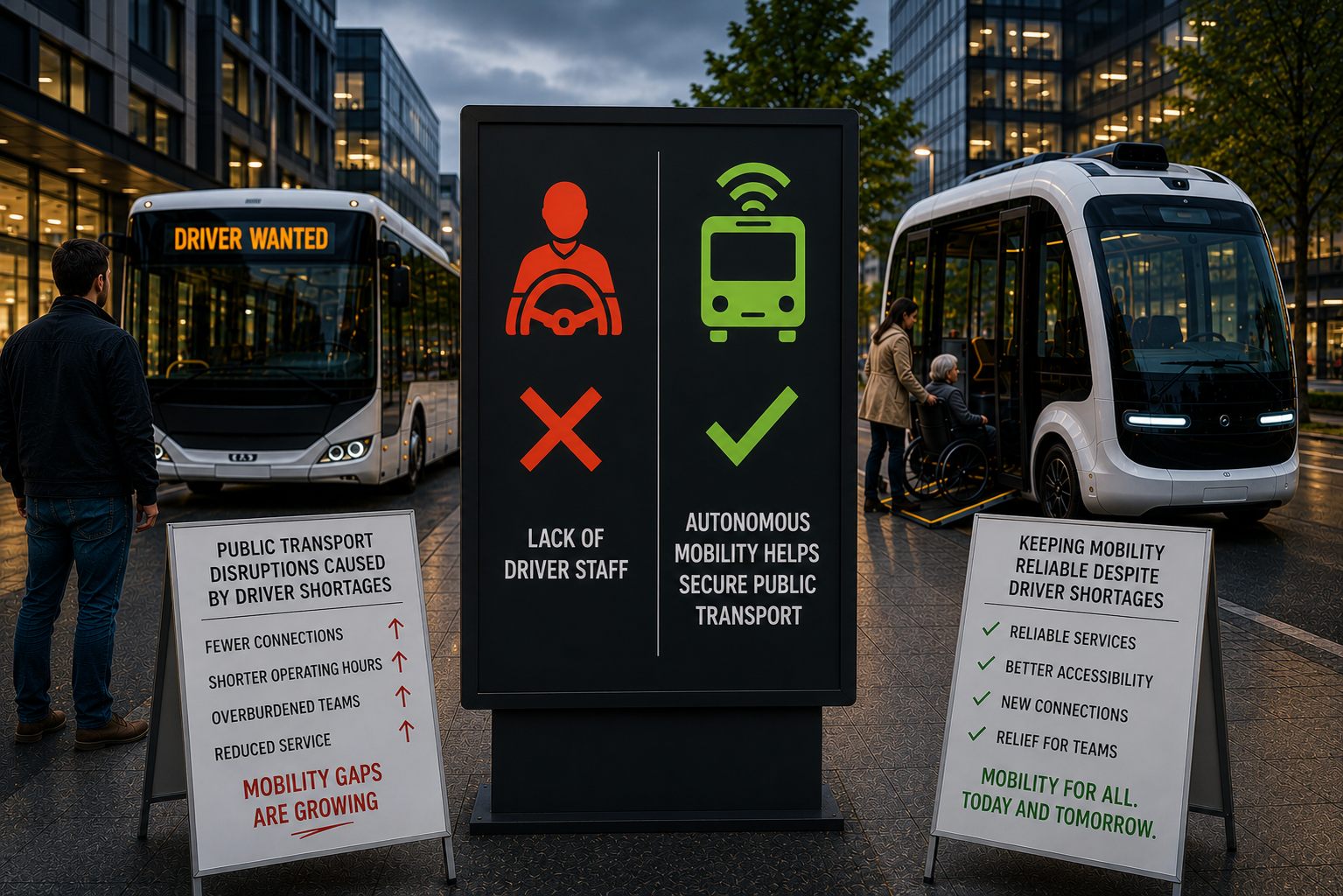
Autonomous mobility is not just a technological showcase. It is also a response to a problem that has been reshaping public transportation for years: the shortage of qualified staff.
For too long, the driver shortage in public transit was treated as an isolated operational issue. Some shifts remained unfilled. Some services had to be reduced. Some new routes could not be established reliably. Today, it is clear that this is no longer about occasional bottlenecks. The real question is how public mobility can be maintained, expanded, and made reliable in the future.
The German federal government explicitly identifies the shortage of professional drivers as one of the central challenges for mobility in Germany.
Source: More information
This also changes the role of autonomous mobility. It becomes relevant because the existing system is under increasing pressure in terms of staffing and availability. Public transportation in particular faces a dual challenge: services must remain stable while accessibility, frequency, and coverage need to improve. Given the acute shortage of staff, this is becoming increasingly difficult in many places.
The Handbook on Autonomous Driving in Public Transport makes it clear that staffing is not a side issue, but a distinct area of planning and implementation. It explicitly addresses personnel and finances as central dimensions of future operations.
Source: More information
This is precisely why it is too narrow to describe autonomous mobility merely as an efficiency technology. At its core, the issue is about the future viability of public transport services. When frequencies are reduced due to a lack of staff, gaps appear in the system. When new routes cannot be introduced despite existing demand, public transport loses reach. When service hours shrink or reliability declines, public trust is weakened. The shortage of qualified personnel is therefore not a marginal issue. It is a structural reality, and autonomous systems can make a meaningful contribution to addressing it.
Not as a simple replacement for human labor, but as a new operational logic that allows certain services to be organized differently: complementary, flexible, and connected to control centers, technical supervision, service operations, and fleet management.
An international perspective: Singapore addresses the staffing issue with unusual clarity. The Ministry of Transport explicitly states: “AVs will add to our public transport network without running up against fundamental manpower constraints.” This shows that, internationally as well, the driver shortage is not merely an operational problem. It is a strategic reason to consider autonomous mobility as part of public transportation in the first place.
Source: More information
For autonomous mobility to truly reduce this pressure, however, technical driving capability alone is not enough. Relief only comes when technology becomes a reliable part of daily operations.
After all, the real question is not simply: How do we replace missing staff? The more important question is: How do we secure public mobility under new conditions? How do we maintain services where staff are scarce? How do we create new connections where traditional models reach their limits? And how do we build a public transit system that remains reliable despite a shortage of skilled workers?
The German federal government therefore links autonomous driving to the goal of creating new mobility services and strengthening public transportation in rural and outlying areas.
This is where the strategic importance becomes clear. The driver shortage does more than increase pressure on the system. It shows why the debate around autonomous mobility cannot be postponed. Anyone who wants to secure the future of public transportation must start developing solutions today for staffing shortages, operational stability, and new service models.
Autonomous mobility is becoming relevant because it can help ensure that reliable transportation remains available in a system under strain.
Anyone planning autonomous mobility in public transit should not treat the driver shortage as a side issue. It belongs at the strategic center of the debate.