
The Future of Local Public Transport — Smaller, More Flexible, More Integrated
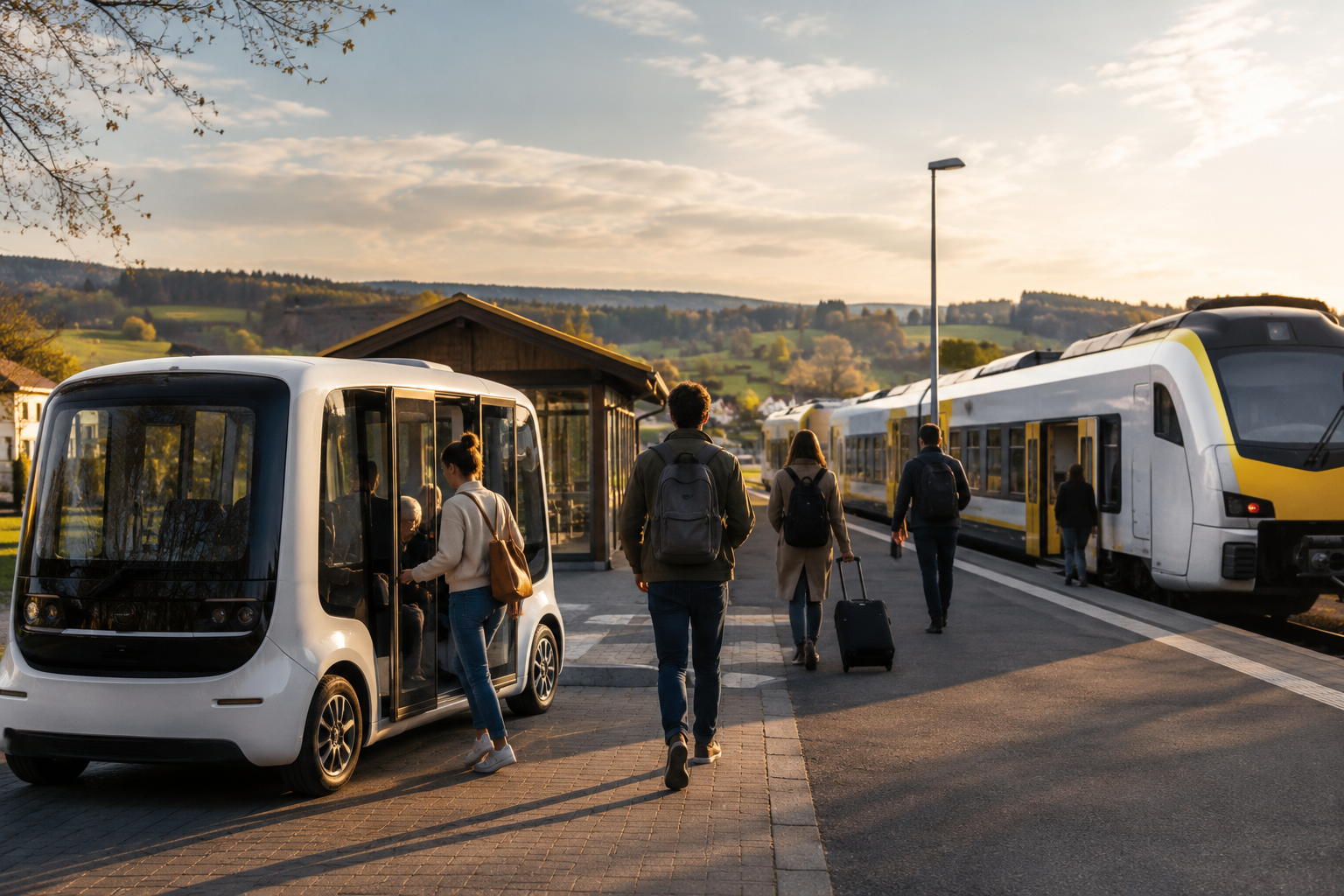
Local public transport of the future will not necessarily expand everywhere. But in many places, it needs to improve: becoming more responsive, more flexible, and better aligned with how people actually travel.
This is precisely where the real opportunity for autonomous mobility in public transport lies. Not in simply replicating existing systems, but in strengthening public transport where traditional scheduled services reach their limits: on the first and last mile, in areas with lower demand, during off-peak hours, and wherever rigid schedules no longer align with real-world mobility needs.
The German federal government explicitly describes autonomous mobility as an opportunity to complement public transport and enable new mobility options, particularly in rural areas and regions far from urban centers.
Source: More information
The future of public transport lies in smarter connections as much as in larger networks. Autonomous services become relevant when they complement existing systems in a meaningful way: as shuttles to train stations, as on-demand services between neighborhoods, and as a way to fill gaps where scheduled service alone is unavailable, insufficiently precise, or economically difficult to sustain.
The Handbook on Autonomous Driving in Public Transport considers autonomous services precisely in this context. It describes them as part of integrated service concepts and emphasizes their integration with existing transport infrastructure, demand patterns, and operating models.
Source: More information
This reflects a fundamental shift in how public transport is being viewed. For decades, public transport was largely built around fixed routes, large vehicles, and clearly defined schedules. That framework remains important. But it is no longer sufficient everywhere. Especially where demand fluctuates, distances are greater, or conventional services are being reduced, new forms of public mobility are needed—not as a retreat from public transport, but as its evolution.
Within this framework, autonomous mobility can fill a gap that public transport has often struggled to address: between private transport and traditional scheduled services, between rural communities and urban transit connections, and between political ambitions and infrastructural realities. The crucial question is whether it actually makes public transport more accessible, reliable, and useful in everyday life.
An international perspective: In Singapore, this concept of complementary transport has already been articulated in very concrete terms. The Ministry of Transport has announced: “We will start by deploying autonomous shuttles to operate scheduled, fixed-route services within our towns.” It further states: “These shuttle services can directly connect residents to key transport hubs and amenities such as the market and polyclinic.” This is no longer a technical trial, but a highly tangible vision of future local transport.
Source: More information
After discussing system governance, oversight, accountability, trust, and structural challenges, it is important to ask what all of this is ultimately intended to achieve. Autonomous mobility is not relevant simply because it is technically possible. It is relevant because it has the potential to improve public transport for more people in more situations.
For that to happen, however, more than good ideas is required. A more flexible and integrated service only creates value if it operates reliably. If vehicles are available. If transfers work. If systems perform consistently. And if new service models are not only attractive on paper but genuinely compatible with everyday life.
Bitkom also advocates for larger real-world deployment environments and makes it clear that new mobility services should not be developed as isolated experiments, but within larger service areas and with larger vehicle fleets.
Source: More information
This creates a new vision for the future of public transport. It is not simply an expansion of existing services. It is a system that responds more flexibly to geography, demand, and user needs. Smaller where large buses are not practical. More flexible where rigid schedules fall short. More integrated where gaps still exist between different parts of a journey.
Autonomous mobility thus becomes a tool for making public transport more precise, accessible, and effective.