Vehicle Motion Assurance: How Motion Requests, Vehicle State, and Drive-by-Wire Execution Interact
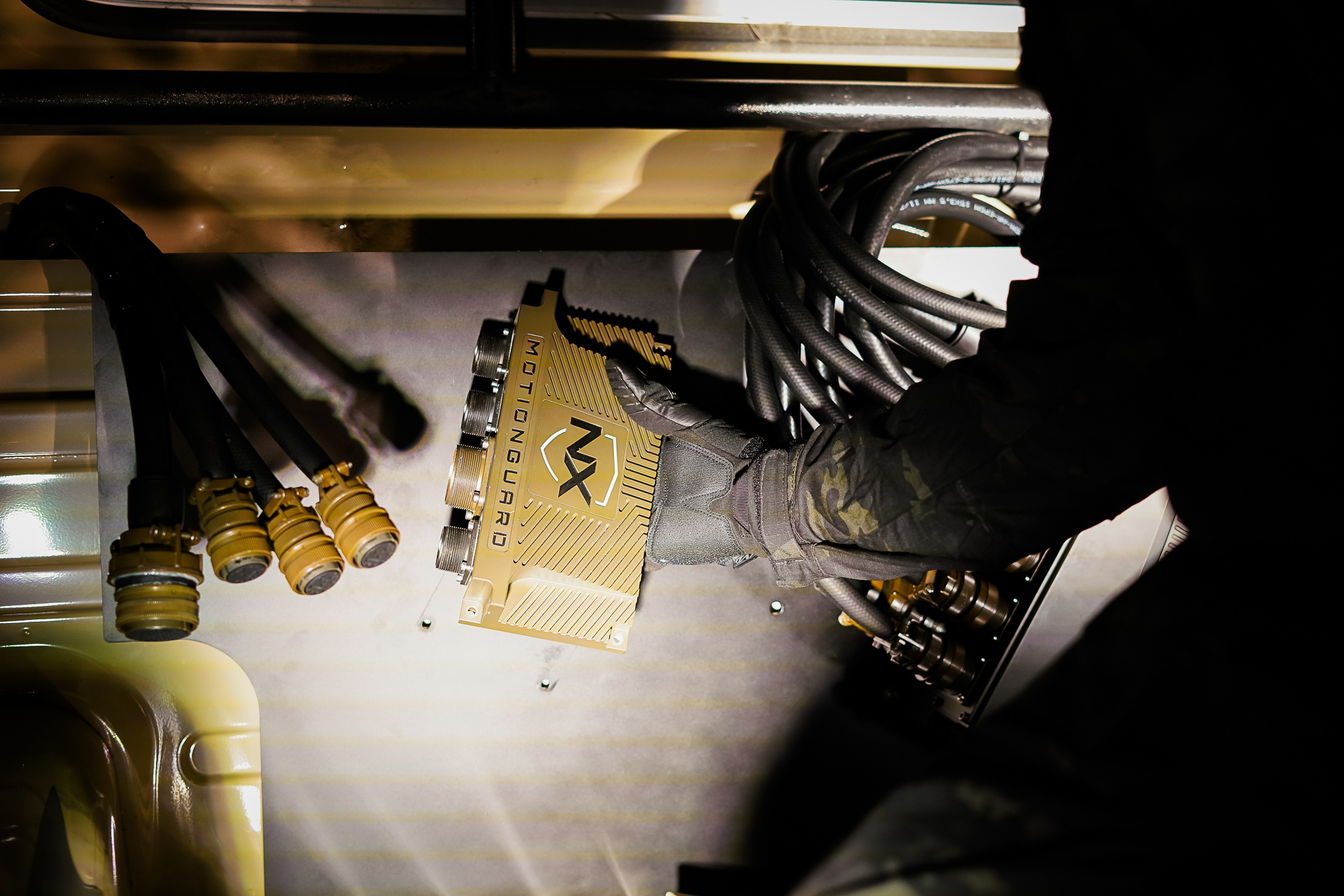
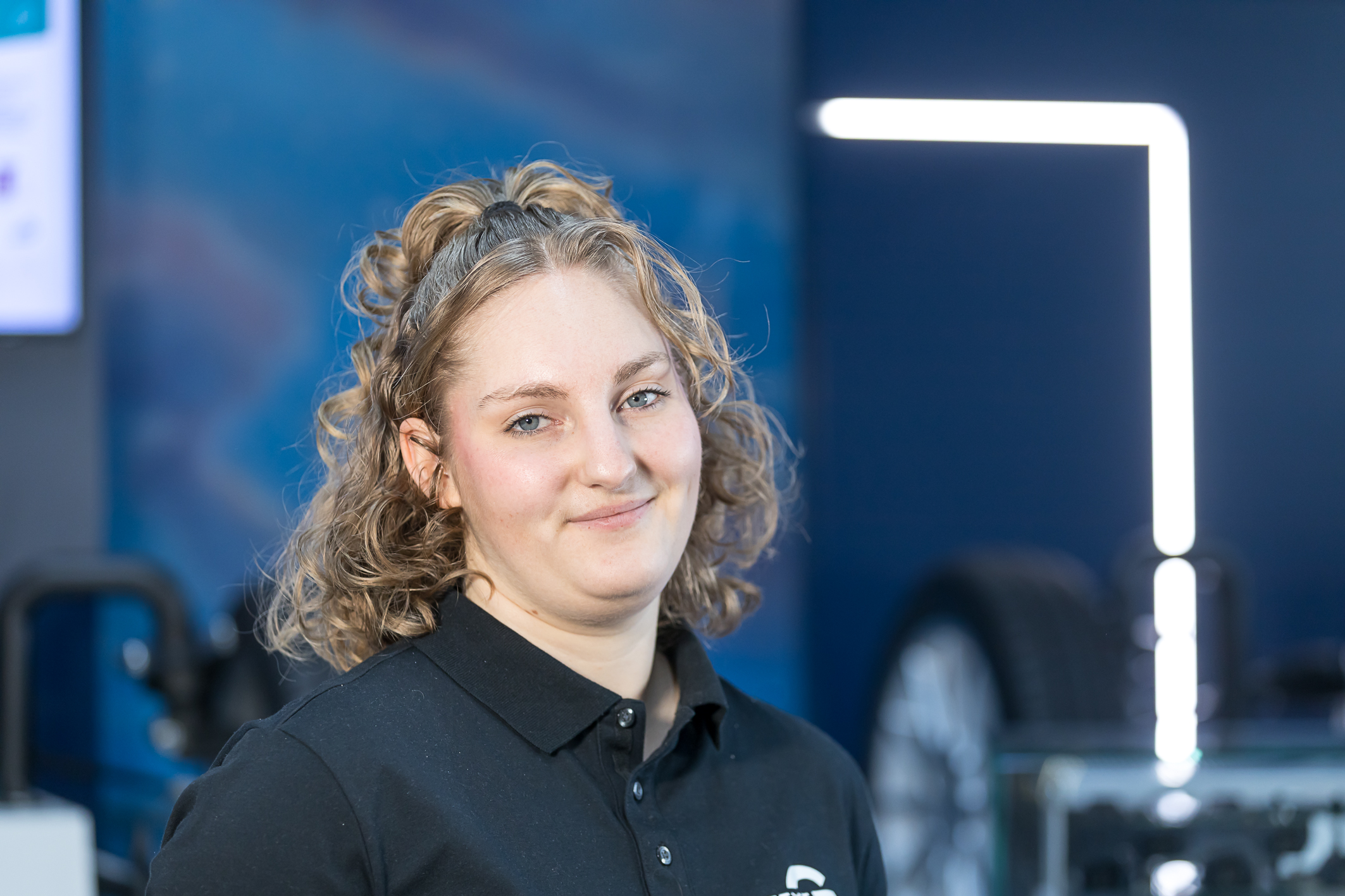
Integration into the actual platform: NX MotionGuard is integrated into the system architecture on a vehicle-specific basis. Interfaces, parameterization, and validation are tailored to the respective target platform. Photo: Arnold NextG
A motion request does not automatically translate into controlled vehicle motion. NX MotionGuard bridges the gap between the digital motion request and what the actual platform can execute under current conditions.
The first five articles in this series have examined, step by step, the prerequisites for controlled digital vehicle motion with a focus on modern defense platforms: the digitization of existing vehicles, teleoperation, scalable drive-by-wire architectures, the coordination of different control sources, and finally, the question of which functions remain available even after faults occur. In defense applications in particular, motion requests can originate from a wide variety of systems—from an autonomy stack, a mission control system, a teleoperation solution, remote control, or, in the future, even from cooperative vehicle functions such as platooning.
One system boundary has been deliberately left open: A vehicle may be digitally controllable. A control source may be unambiguously authorized. The drive-by-wire control layer may be available and capable of executing a motion request. However, this does not answer the question of whether this motion can be executed in a controlled manner as requested under the current conditions of the real-world platform. This is precisely where Vehicle Motion Assurance begins.
Technological Core
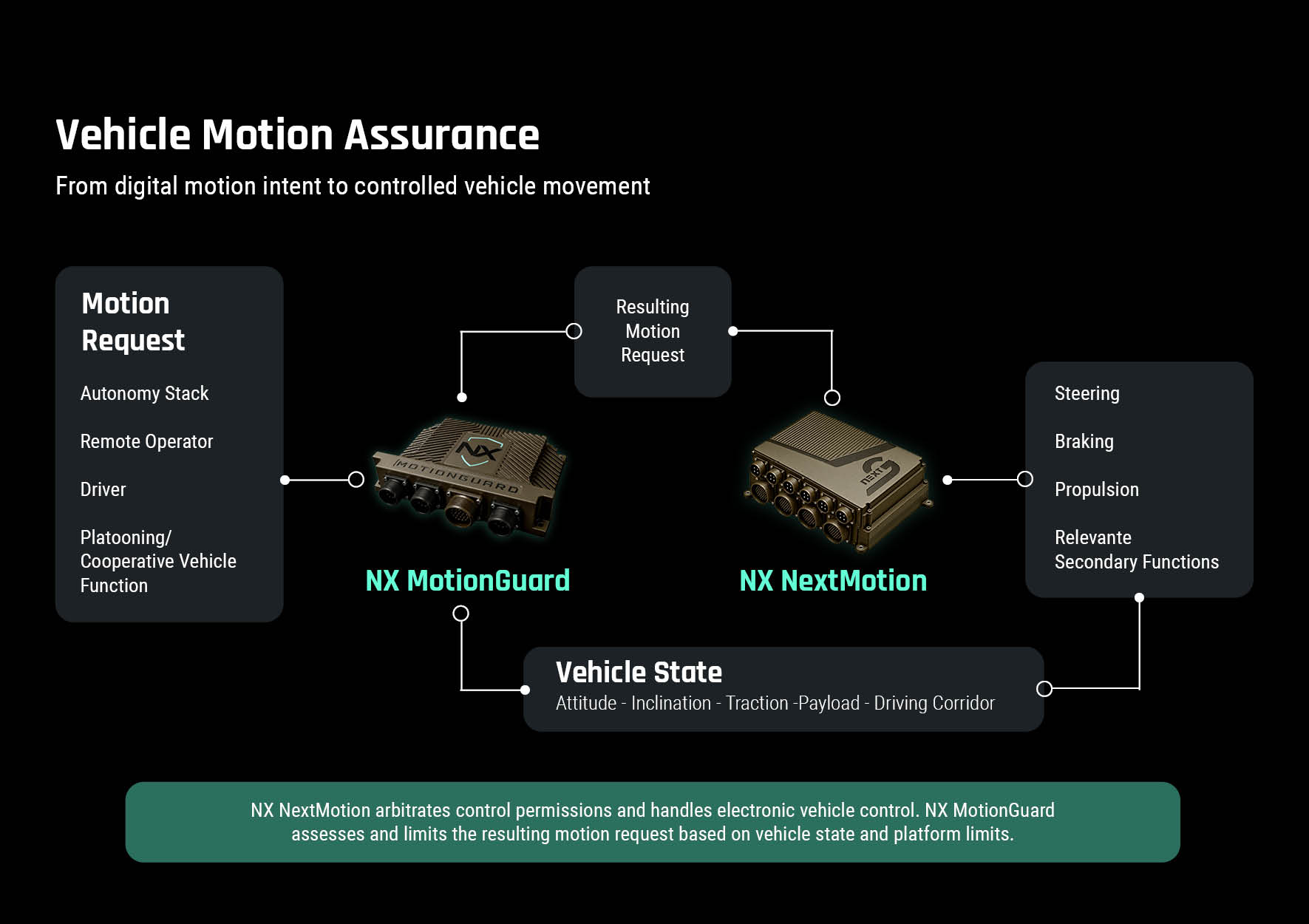
A higher-level system generates a motion request. NX MotionGuard evaluates this request in the context of the vehicle’s current state and the defined platform limits, and restricts it if necessary. NX NextMotion then takes over the electronic execution of the resulting motion request via steering, braking, propulsion, and relevant secondary functions.
This division of tasks can be summarized in a simple formula: AD plans. NX MotionGuard assures. NX NextMotion executes.
A motion request is not yet an actuator command
A motion request can originate from various sources: an autonomy system, mission control, a teleoperation solution. It initially describes how the vehicle should move—for example, along a trajectory or a driving corridor, at a specific speed, or to a defined stopping point. However, there is a crucial level of abstraction between this description and the actual control of the steering, brakes, and drivetrain. This is because a motion request initially describes the target state. The actual platform provides the current state.
And this actual state can change: load, incline, available traction, vehicle condition, or currently applicable system limits all influence which movements can be executed in a controlled manner under the given conditions. The same digital request may therefore require a different vehicle-side evaluation at different times or on different platforms. Vehicle Motion Assurance brings precisely these two information spaces together: What is being requested? And: What can the actual platform execute in a controlled manner under the current conditions?
Evaluation Requires Vehicle Context
NX MotionGuard relates the motion request to the actual state of the platform. This is not about a single measured value, but rather the interplay of various vehicle-side pieces of information: How is the vehicle positioned in space? What traction is available? How is the platform loaded, what is its condition, and what spatial boundaries—such as driving corridors, elevation profiles, or defined stopping points—apply to the current motion?
Only by considering this context can one assess whether a requested movement can be executed as is under the current conditions or must be restricted. What matters, therefore, is not merely what is digitally requested, but whether this request aligns with the platform’s actual conditions. This shifts the focus from the mere transmission of a digital command to the vehicle-side assessment of whether the request can be executed within defined limits.
Why the Interface Must Be Bidirectional
Vehicle Motion Assurance cannot function solely on the basis of the originally requested motion. The vehicle’s current state must be fed back into the assessment. Therefore, communication between the higher-level system, Vehicle Motion Assurance, and the vehicle’s execution is not a one-way street. States, limits, and availability can be reported back via the vehicle architecture and taken into account for subsequent motion requests.
A linear transmission of a digital command to the vehicle thus becomes a bidirectional flow of information: A motion request is evaluated, executed on the platform, and fed back along with the actual vehicle state. This feedback, in turn, forms the basis for the further evaluation of subsequent motion requests. The return channel is thus more than mere status communication. It ensures that digital motion requests can be continuously reconciled with the platform’s current state. This is precisely what distinguishes Vehicle Motion Assurance from a static interface between a higher-level system and the vehicle.
Limiting Is Not the Same as Replanning
An important architectural boundary lies between motion planning and Vehicle Motion Assurance. NX MotionGuard is not an additional autonomy stack and does not replace an AD kit. The higher-level system remains responsible for the desired motion. NX MotionGuard does not replan this motion, but rather evaluates the requested motion on the vehicle side and, if necessary, limits it within defined boundaries.
This separation is important. Otherwise, higher-level decision logic, vehicle state evaluation, and safety-critical vehicle execution would all converge at the same system level. The Arnold NextG architecture deliberately separates these tasks: The higher-level system formulates the desired motion, NX MotionGuard evaluates and limits this request in the context of the actual platform, and NX NextMotion handles the vehicle-side drive-by-wire execution. This ensures that it remains clearly defined which level bears which responsibility.
Arbitration also remains separate
This distinction becomes particularly relevant when multiple control sources converge on the same platform. As described in Part 4, drivers, remote operators, and automated driving systems may have different control rights. NX NextMotion continues to determine, as part of control arbitration, which source is authorized to control which vehicle function under a specific system state.
NX NextMotion handles the arbitration of control permissions between different command sources and provides safety-critical electronic vehicle control. NX MotionGuard evaluates and limits the resulting motion requirements, taking into account the actual vehicle state and the defined platform limits.
This keeps two architectural questions clearly separate: Who holds the control authority? And can the respective motion request be executed in a controlled manner under the vehicle’s current conditions? NX NextMotion answers the first question via Control Arbitration, while NX MotionGuard answers the second via Vehicle Motion Assurance. The resulting motion requirements are then translated into vehicle motion by NX NextMotion via the drive-by-wire control layer.
A concrete example of this interaction is “Coming Home”: Depending on the system configuration, a “Coming Home” function can assist in guiding the vehicle back to a defined starting point.
Why this separation becomes important across different platforms
Vehicle Motion Assurance gains additional importance when higher-level systems are to be connected to more than one vehicle platform. The same trajectory or speed request encounters different physical conditions on a light wheeled vehicle than on a heavier platform or a tracked vehicle. Even within the same platform, boundary conditions can change—for example, due to varying loads, inclines, or traction.
Consequently, the same trajectory or speed request cannot automatically be equated with identical vehicle-side conditions. NX MotionGuard establishes a defined layer between the abstract motion request and the specific target platform. However, this does not mean that platform differences disappear. Parameterization, integration, and validation remain vehicle-specific. It is precisely this separation that is crucial for scalable architectures: The higher-level planning does not have to map out all the details of the actuator system itself, while Vehicle Motion Assurance can simultaneously be tailored to the characteristics of the specific target platform.
Vehicle Motion Assurance as a System Boundary
This makes it clear that NX MotionGuard is not simply another function within an existing signal chain. The Vehicle Motion Assurance Layer forms a distinct functional layer at this system boundary. Above this boundary, a desired motion is generated. Below this boundary, the actual platform must implement this motion in a controlled manner. NX MotionGuard connects both sides by aligning the motion request with the current vehicle context. NX NextMotion then handles the safety-oriented execution through the vehicle functions.
The result is a clearly separated processing chain: The starting point is the motion request from a higher-level system. NX MotionGuard correlates it with the current vehicle state and the defined platform limits. If the request can be executed as is, it remains unchanged; otherwise, it is limited within the specified boundaries. NX NextMotion then handles the drive-by-wire execution and implements the resulting motion request via steering, braking, propulsion, and relevant secondary functions.
However, this chain does not function in just one direction. Relevant vehicle states, available functions, and effective limits are fed back into Vehicle Motion Assurance and are thus available for further evaluation of motion requests. A linear command chain is thus transformed into a bidirectional architecture in which digital motion requests and the actual state of the platform are continuously linked.
From the Control Gap to a Defined Architecture
The Control Gap thus describes not only an interface between software and the vehicle, but also a distinct architectural task: Digital motion requests must be correlated with the platform’s actual capabilities before controlled vehicle motion can result.
This distinction is becoming increasingly important, particularly for automated, teleoperated, and unmanned defense platforms. The more complex the higher-level systems become and the more diverse the vehicle platforms used are, the more important it is to have a clearly defined functional boundary between digital motion planning and actual vehicle execution.
The Complete Motion Chain
NX MotionGuard thus completes the technological spectrum of this series. Digital controllability, teleoperation, scalable drive-by-wire architecture, control arbitration, and operational availability combine to form a seamless architecture for controlled vehicle motion.
AD plans. NX MotionGuard assures. NX NextMotion executes.
WE CONTROL WHAT MOVES
Sources and Technical Context
Arnold NextG, press release dated November 10, 2026:
“NX MotionGuard bridges the gap between digital motion commands and controlled vehicle movement.”
Arnold NextG, NX MotionGuard
ATZheavy duty 02/2026, Technical Article
„Drive-by-Wire Platform for Integrating Different Control Sources “

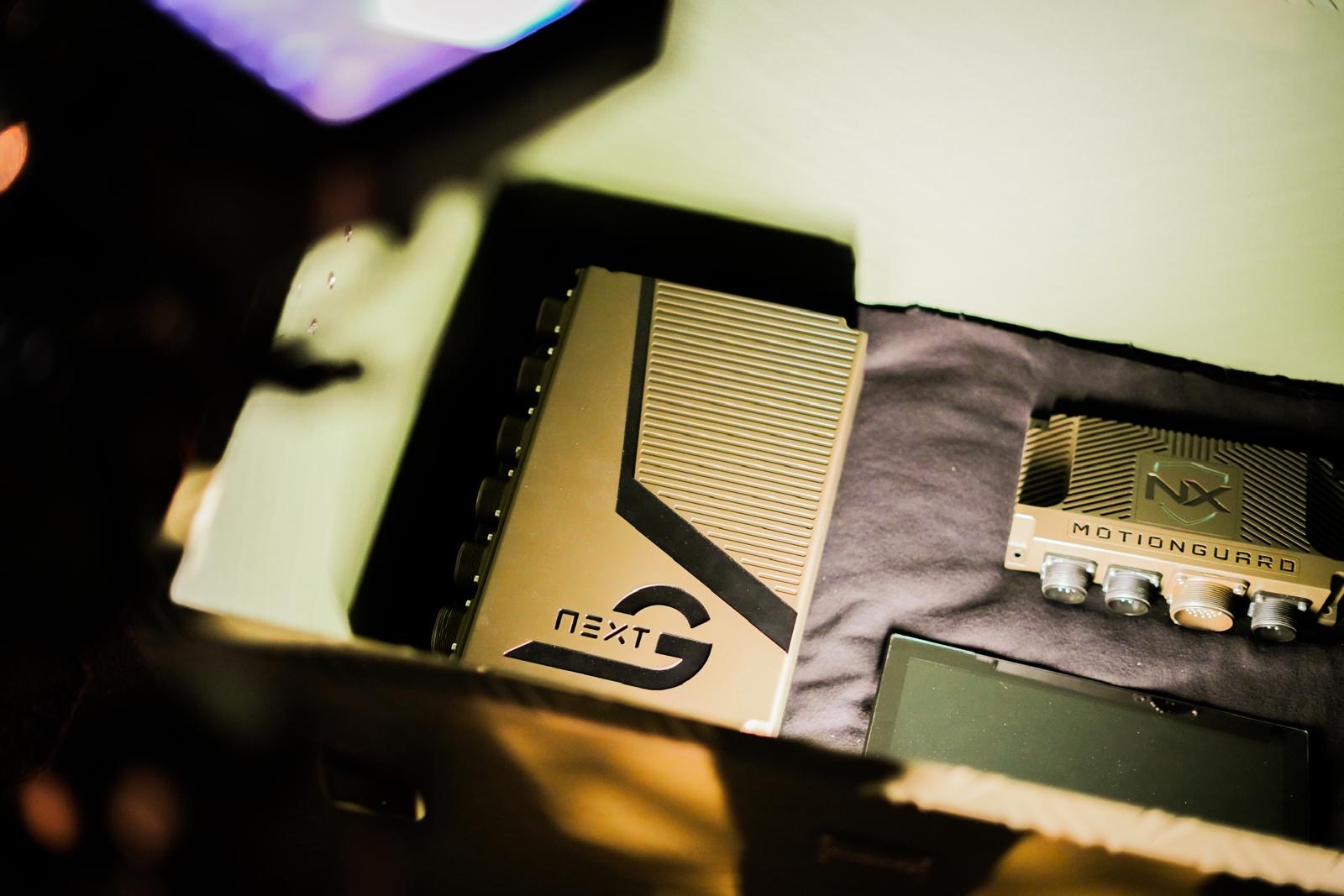
Two levels, one unified architecture: NX MotionGuard handles Vehicle Motion Assurance, while NX NextMotion manages drive-by-wire execution—from the digital motion request to controlled vehicle movement. Photo: Arnold NextG
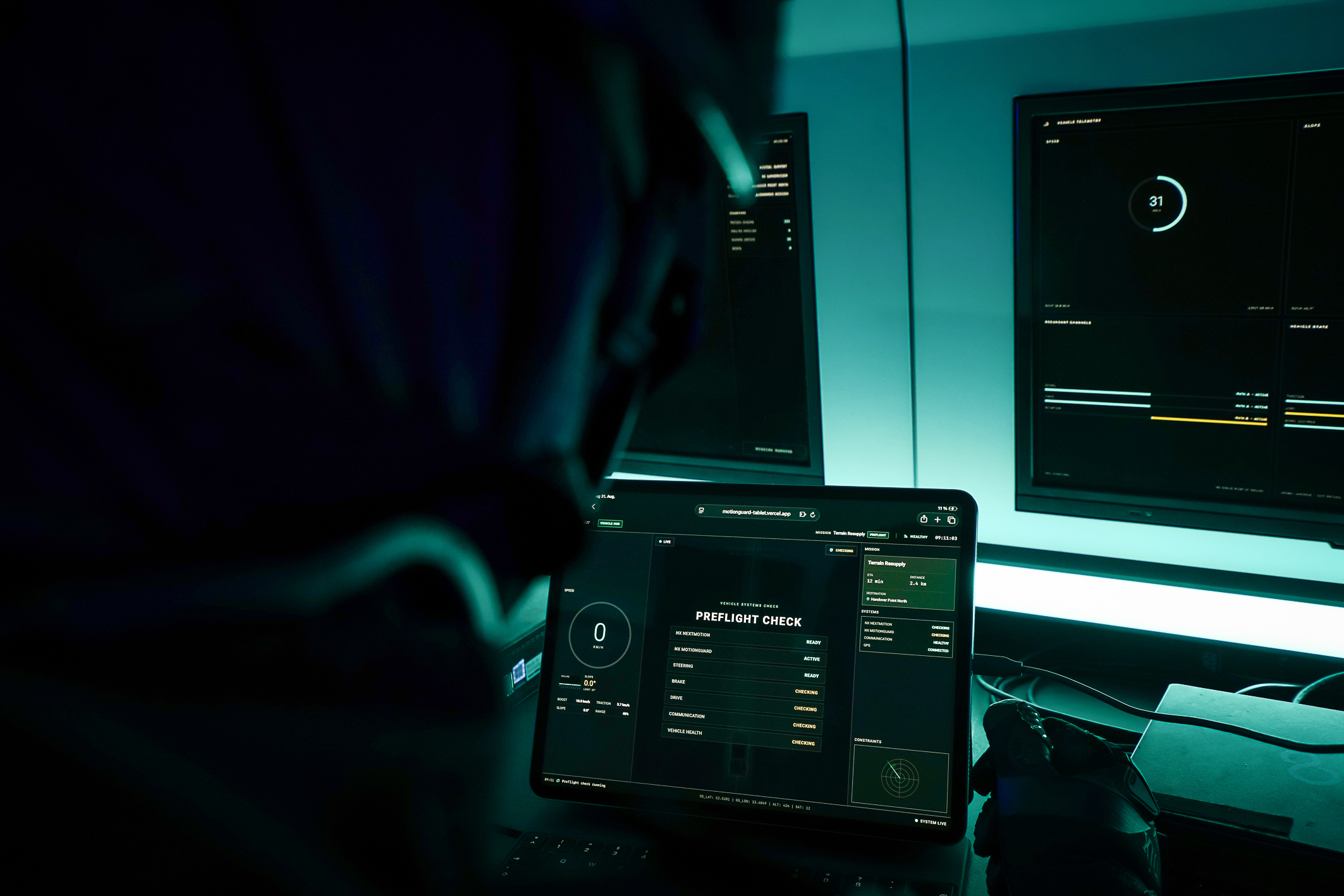
Vehicle Motion Assurance in a system context: The NX MotionGuard interface displays vehicle states, availability, and relevant system information, thereby laying the foundation for evaluating motion requests. Photo: Arnold NextG