
Who’s actually running this?
Why system responsibility determines scalability
Autonomous mobility needs one thing above all else—responsibility.
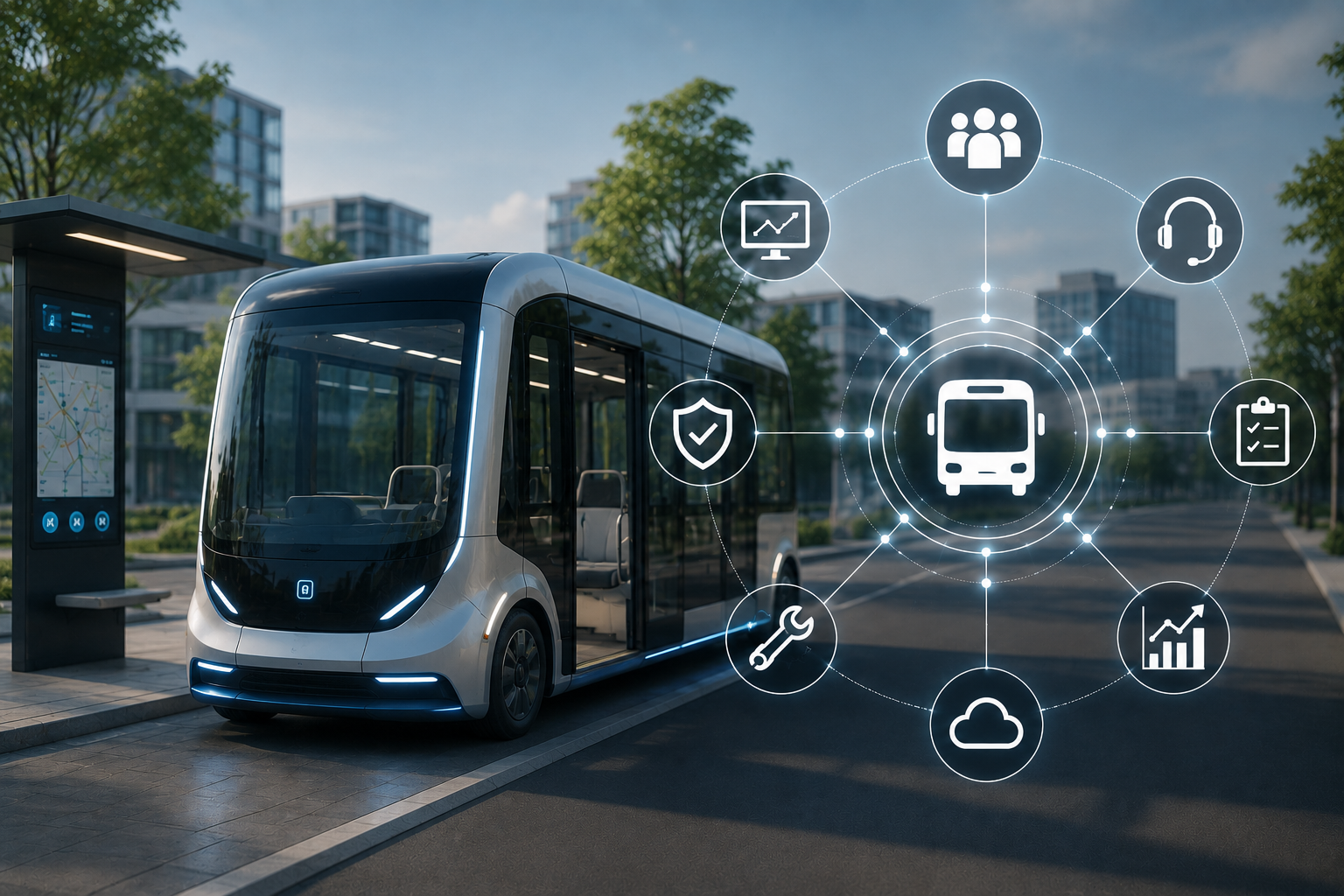
Here, the debate often becomes too technical and, as a result, too narrow. Sensors, software, and driving functions are visible. But the real yardstick for public transportation lies elsewhere: Who bears responsibility in everyday life? Who monitors the system? Who steps in when things don’t go as planned? Who organizes the control center, technical supervision, service, maintenance, and intervention? As long as these questions remain unanswered, autonomous mobility will remain limited, even if the technology works in principle.
The German government identifies precisely this gap. Its strategy states that there is currently a lack of scalable operator and business models for autonomous shuttle services.
Source: More information
This is a crucial point. After all, an autonomous vehicle does not yet constitute an autonomous service. A service only comes into being where operations are organized, responsibility is assigned, and reliability is established. In public transportation, this means: A system must not only operate, but function reliably on a daily basis. It must be accessible, operable, monitorable, and maintainable.
The Handbook on Autonomous Driving in Public Transportation describes autonomous services as a systemic challenge in which operations, safety, technical oversight, and organizational implementation must be considered together.
Source: More information
This is precisely why it is not enough to discuss autonomous mobility solely as a matter of automation. In operation, the focus shifts. Where today a human in the vehicle implicitly ensures many things, tomorrow the system will require clearly defined roles, responsibilities, and intervention logic. Technical supervision, control centers, teleoperation, service, maintenance, and fleet management are then no longer peripheral functions, but part of the operational architecture. However, this form of system responsibility can only be organized in a stable manner if the underlying vehicle control system itself is designed to be system-compatible—that is, if it functions consistently, reproducibly, and independently of individual platform logics.
In public transit, this is an organizational issue under real-world conditions: availability, shift scheduling, incident management, responsibilities, and interventions must be designed to be resilient. This is precisely where it becomes clear whether autonomous mobility will actually become integrated into regular operations.
An international perspective: France isn’t just talking about vehicles, but specifically about “automated vehicles and mobility services.” This is more than a linguistic nuance. It shifts the debate from the product to the service—and thus to the question of how operations, responsibility, and implementation are organized.
Source: More information
This also makes it clear why system responsibility is more than just traditional operator logic. It encompasses not only day-to-day operations but also the ability to consistently organize controlled movement under real-world conditions. And how can all of this be designed without relying on permanent exceptional measures?
At this point, the technical level becomes relevant again. After all, operations can only be reliably organized if the underlying vehicle control remains controllable in the first place. Technical supervision and control centers can only rely on systems that behave in a controlled, traceable, and reproducible manner.
This also changes how we view roles within the system. Autonomous mobility does not simply replace staff; it shifts responsibility. A single driver’s workstation evolves into an interplay of technical supervision, a control center, fleet management, service, maintenance, and intervention. Human responsibility does not disappear; it is reorganized.
The handbook makes it clear that precisely these personnel and organizational issues must be integrated early on in planning and operations.
Source: More information
This is central to scaling. If operations function only under project conditions, with special logic and a great deal of implicit additional effort, a resilient public system cannot emerge. If, on the other hand, responsibilities are clearly distributed, technically viable, and structured to be organizationally compatible, the foundation for availability and growth is established.