Controlled Motion for Autonomous and Unmanned Vehicles
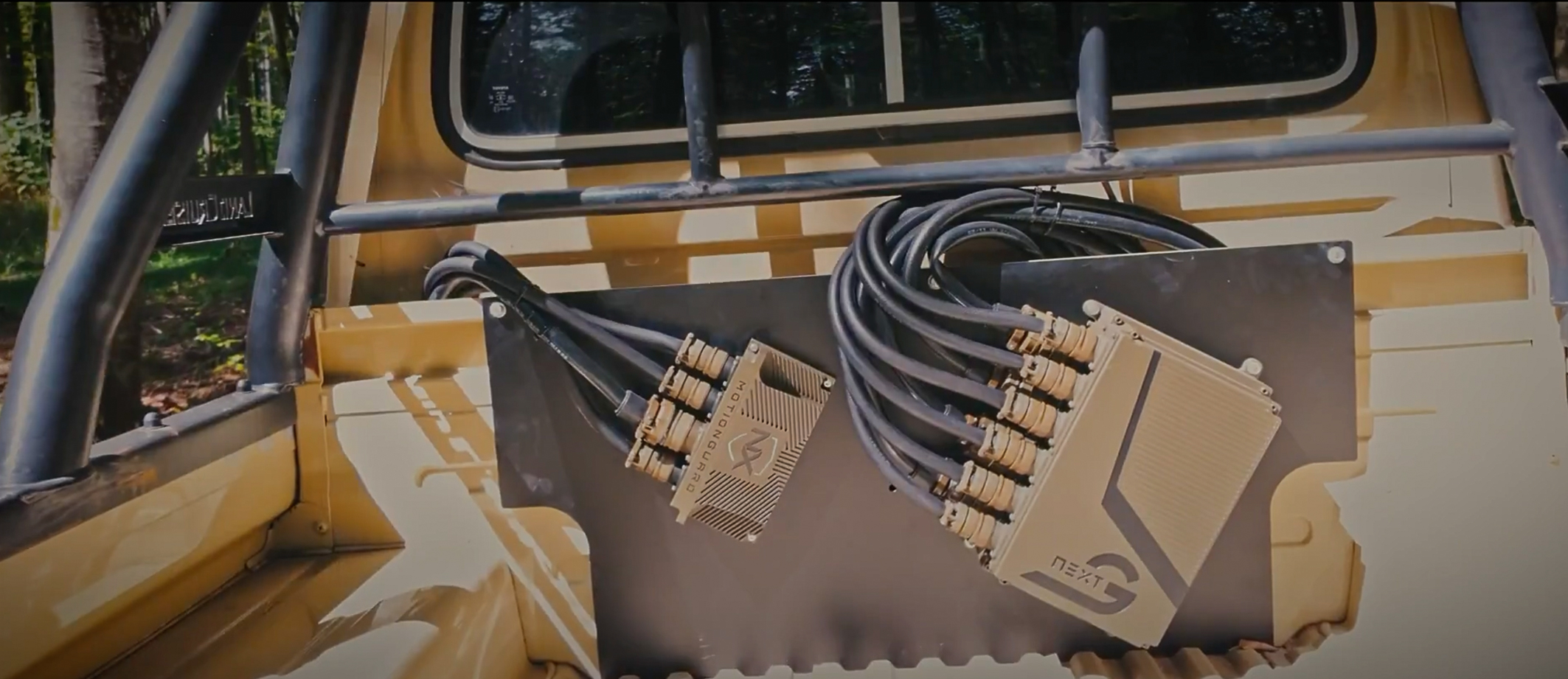
NX NextMotion and NX MotionGuard working together: Arnold NextG supplements its drive-by-wire technology with Vehicle Motion Assurance and links electronic vehicle control with the evaluation and monitoring of digital motion requests. Photo: Arnold NextG
NX MotionGuard bridges the gap between digital motion commands and controlled vehicle motion
Pfronstetten-Aichelau, November 10, 2026 – Autonomous and unmanned vehicles are increasingly taking on tasks in demanding defense applications—from reconnaissance and logistics to autonomous convoys. These systems can sense their environment, plan routes, calculate trajectories, and make decisions. The real challenge, however, begins where digital motion commands meet real-world vehicle physics. This is because terrain, traction, payload, and vehicle condition all play a role in determining whether a planned movement can actually be executed in a controlled manner.
With NX MotionGuard, Arnold NextG is expanding its existing control architecture to include an additional layer for Vehicle Motion Assurance. The new on-board solution evaluates, limits, and monitors digital motion requests in the context of current vehicle conditions. Together with the NX NextMotion drive-by-wire platform, this creates a seamless control architecture from digital decision-making to controlled vehicle motion – based on the “Command to Controlled Motion” principle.
NX MotionGuard is aimed in particular at manufacturers, system integrators, and operators of automated, teleoperated, and unmanned defense platforms. The product addresses the so-called “control gap”: the system boundary between what a higher-level autonomy or mission system requests and what the actual vehicle platform can execute in a controlled manner under current conditions.
“Autonomous systems today can see, analyze, and make decisions. However, the crucial question is whether these decisions can be implemented in a controlled manner under real-world conditions,” says Kevin Arnold, CEO of Arnold NextG. “With NX MotionGuard, we bridge the gap between digital motion commands and physical vehicle movement. Together with our fail-operational NX NextMotion drive-by-wire system, we create an end-to-end control architecture—from the digital decision to the vehicle actuators.”
From Decision to Movement
NX MotionGuard is not just another autonomy stack, nor is it a replacement for an AD kit. The product performs a clearly defined in-vehicle task: It verifies whether and how a requested movement can be executed in a controlled manner under the platform’s current conditions. The movement requests can originate from various sources—such as an autonomy system, mission control, a teleoperation solution, or driver control. They are integrated into the vehicle architecture via defined, redundant interfaces.
NX MotionGuard evaluates these requests against actual vehicle conditions. Depending on the system configuration, information regarding position, inclination, traction, load, driving corridors, stopping points, and vehicle states is incorporated into the evaluation and monitoring process. The solution takes vehicle-side limitations into account and can adjust or limit requested movements accordingly. Communication is bidirectional: statuses, limits, and availability can be reported back to the higher-level systems. This creates a traceable link between digital motion planning and actual vehicle operation.
Motion Assurance Meets Drive-by-Wire
The architecture brings NX MotionGuard together with NX NextMotion, the drive-by-wire control layer from Arnold NextG. NX MotionGuard handles vehicle motion assurance—that is, the evaluation, limitation, and monitoring of the requested motion. NX NextMotion is responsible for arbitration between command sources as well as electronic execution via steering, braking, propulsion, and relevant secondary functions. The multi-redundant, fail-operational NX NextMotion architecture is designed to maintain vehicle control even in the event of individual component failures.
This functional separation is particularly crucial for automated and unmanned vehicles. Autonomy software, mission systems, or remote operators do not access safety-critical vehicle functions directly or without verification. Instead, there is a defined handoff between digital decision-making, vehicle-side motion evaluation, and physical execution. For vehicle manufacturers and system integrators, this architecture simplifies the integration of different autonomy stacks and mission systems without having to directly link their functions to safety-critical actuator control.
Controlled Movement Under Real-World Operating Conditions
The benefits of Vehicle Motion Assurance are particularly evident in off-road conditions. A digitally planned trajectory may be plausible under ideal conditions. However, on loose or wet surfaces, when the vehicle is tilted sideways, with varying loads, or with reduced traction, the same movement can become significantly more critical. NX MotionGuard evaluates the motion request in the context of the vehicle’s current conditions and takes into account the limitations of the respective platform. This allows movements to be executed in a more controlled and traceable manner, even under changing operational conditions.
Autonomous convoys are one example. Different payloads, platform geometries, traction conditions, or braking reserves can mean that an identical trajectory poses varying levels of risk for different vehicles. NX MotionGuard supports the vehicle-side evaluation of these requests while taking into account defined driving corridors, distances, and stopping points.
With precise 3D route guidance and planning, NX MotionGuard enables controlled movement along defined spatial routes. Terrain profiles, elevation differences, and specified stop points are taken into account. Especially in demanding defense scenarios—such as reconnaissance, mapping, or mine clearance—the precise and repeatable traversal of specified routes is crucial. NX MotionGuard combines 3D route guidance and planning with continuous assessment of actual vehicle conditions.
Different Operating Modes – One Vehicle Architecture
Another area of application is the transition between different forms of vehicle control. For example, an unmanned vehicle can initially be maneuvered at close range by a remote operator. Subsequently, a teleoperator takes over control from a distance. Once in the operational area, the vehicle can continue its mission autonomously. Remote control, teleoperation, and autonomous operation are not isolated applications but can work together within a common vehicle architecture. NX MotionGuard handles the vehicle-side evaluation of motion requests; NX NextMotion is responsible for arbitrating command sources and their controlled execution.
Even if the autonomous driving system fails, it is still possible to guide the vehicle back: Depending on the system configuration, a “Coming Home” function can assist in guiding the vehicle back to a defined starting point. In addition, an integrated fleet management system provides a centralized overview of vehicles and missions. Together with the bidirectional data flow, this supports the traceability of vehicle statuses, motion requests, and mission sequences. The available functions and integration options depend on the respective system configuration and vehicle platform.
Developed for cross-platform use—built on experience
NX MotionGuard is designed for the integration of various autonomy and mission systems. The architecture can be used for both wheeled and tracked vehicles and, with the appropriate technical design, can be retrofitted into existing platforms or integrated into new vehicle concepts from the outset. The Arnold NextG team brings together more than 25 years of experience in the development and integration of safety-critical electronic vehicle control systems. This know-how forms the technological foundation for the further development of the vehicle architecture—from individual electronic control functions to a unified architecture for controlled vehicle movement.
Arnold NextG supports the entire development and integration process: from requirements and system design through engineering, installation, and testing to commissioning and series production integration. With NX MotionGuard, the company is expanding its existing control architecture to include Vehicle Motion Assurance as an additional in-vehicle function. In conjunction with NX NextMotion, this creates a unified architecture for controlled vehicle motion—from the digital motion request to its electronic implementation in the vehicle.
WE CONTROL WHAT MOVES.
For more information, visit: NX MotionGuard
Arnold NextG at DSEI Germany 2027
Arnold NextG plans to present NX NextMotion and NX MotionGuard to an international audience of industry professionals at DSEI Germany, taking place March 9–12, 2027, in Hanover. The focus will be on the interaction of both technologies within a vendor-neutral, open-platform control architecture—from the evaluation of digital motion requirements to their safety-critical electronic implementation via steering, braking, and propulsion. DSEI Germany 2027 | March 9–12, 2027 | Hanover | Hall 25, Booth H25-631
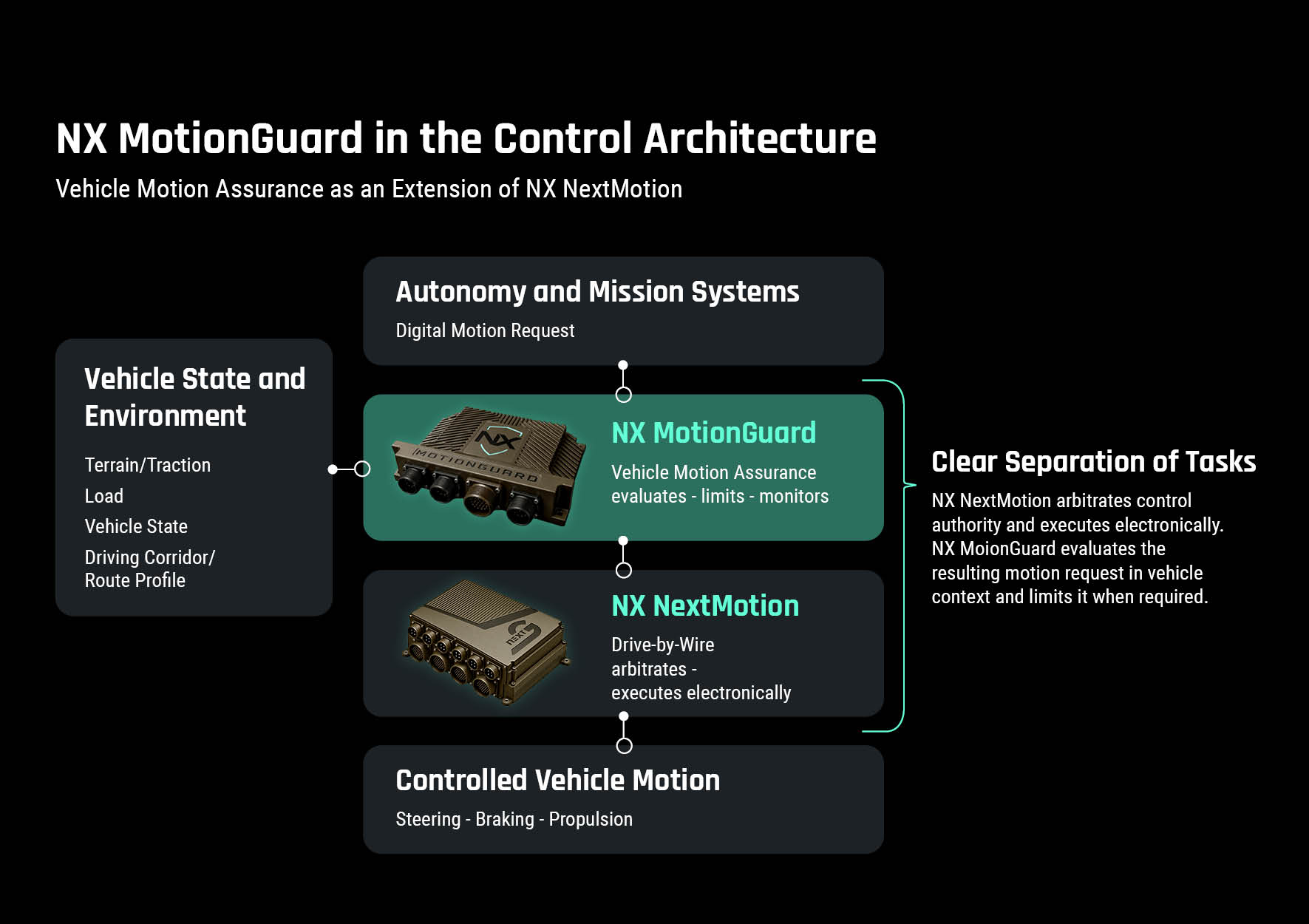
From the digital motion request to controlled vehicle motion: NX MotionGuard evaluates, limits, and monitors motion requests while taking the vehicle’s state into account. NX NextMotion handles the arbitration of command sources and the electronic implementation via steering, brakes, and propulsion. Graphic: Arnold NextG
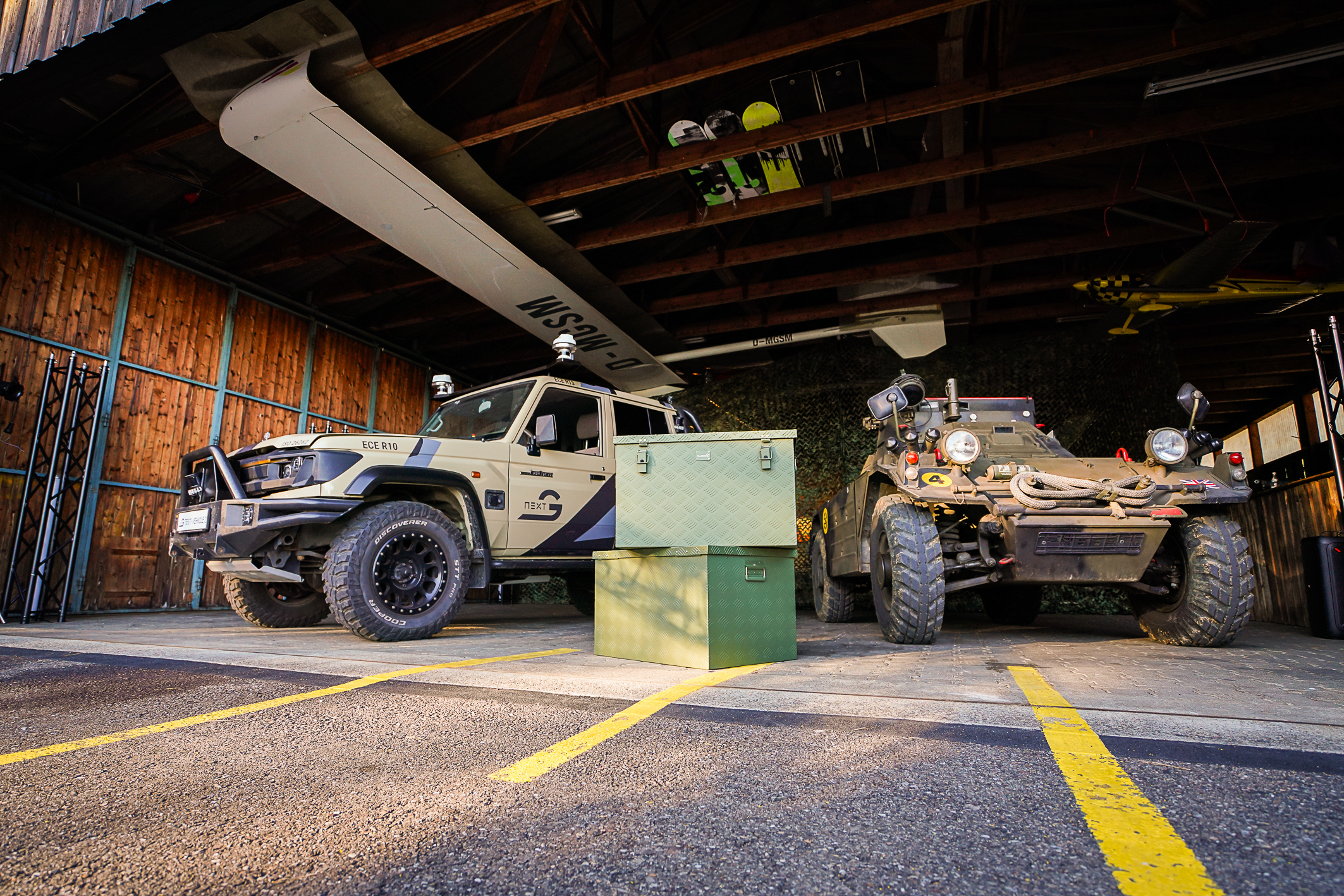
Various vehicle platforms in the defense sector: NX MotionGuard is designed for integration into wheeled and tracked vehicles and supports the controlled movement of autonomous and unmanned vehicles even under demanding operational conditions. Photo: Arnold NextG
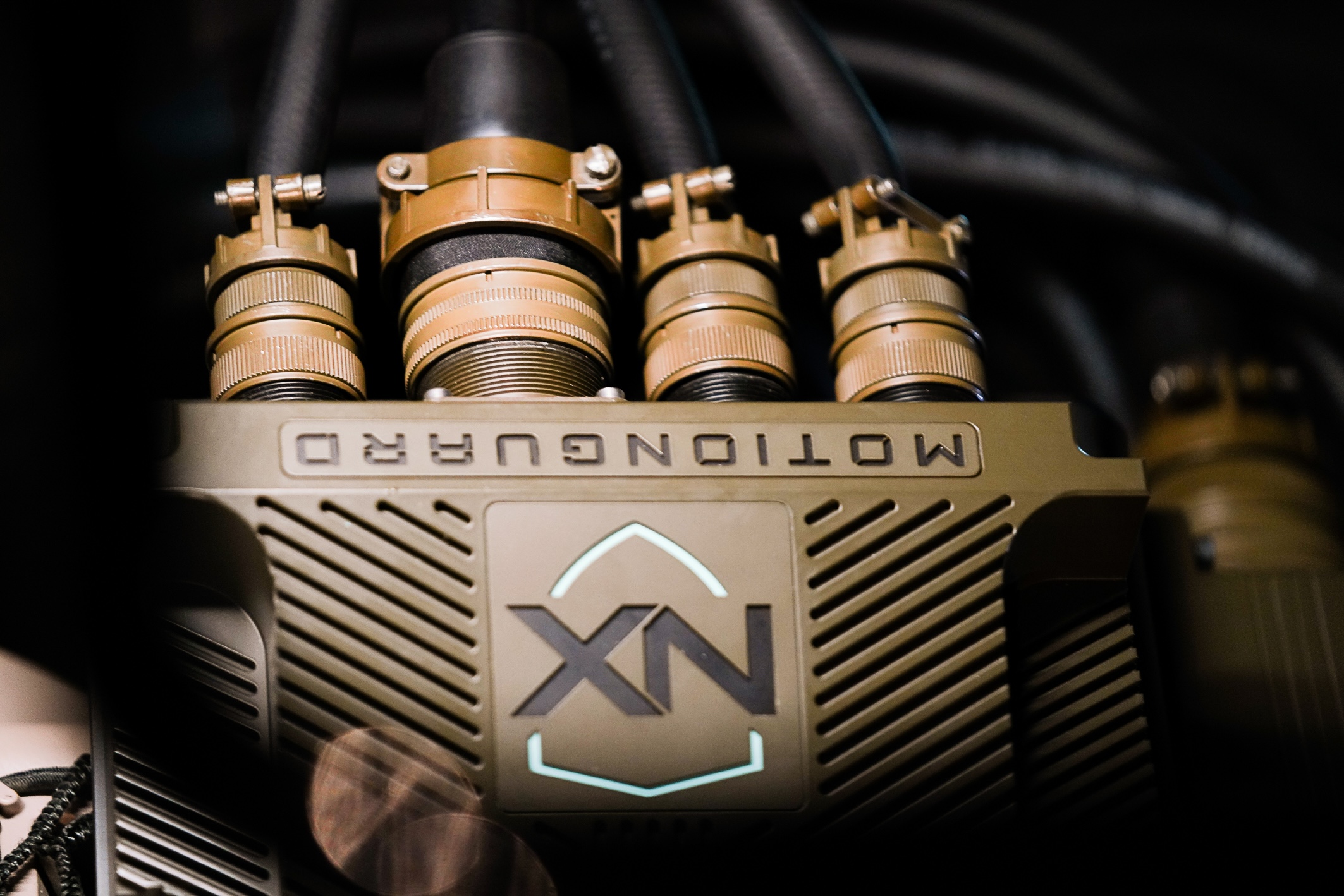
NX MotionGuard supplements electronic vehicle control with Vehicle Motion Assurance. The solution takes actual vehicle conditions into account to evaluate, limit, and monitor digital motion requests. Photo: Arnold NextG
About Arnold NextG:
Arnold NextG develops Safety-by-Wire® technology for the next generation of mobility. The multi-redundant, fail-operational NX NextMotion drive-by-wire control platform enables the electronic control of steering, braking, propulsion, and other vehicle functions. Designed to be manufacturer-independent and platform-agnostic, it forms the foundation for autonomous vehicle concepts as well as for remote control, teleoperation, and platooning solutions. With NX NextMotion, Arnold NextG offers a road-approved drive-by-wire platform that enables development partners to test and integrate new vehicle concepts under real-world driving conditions. The relevant test and certification documents are available. The Arnold NextG team brings together more than 25 years of experience in the development and integration of safety-critical electronic vehicle control systems and supports its customers from concept to series production.
PM_20261110_NXMotionGuard_Fachpresse_EN.pdf